How to Cut a Fade: A Step-by-Step Guide to Low, Mid and High Fades
⏰ Short on time? Here's the summary
A fade is a haircut where the hair gradually shortens from very short to longer hair, with no visible line between lengths. You cut one by first setting three zones with different lengths, then blending them into each other. The difference between a low, mid and high fade is simply the height at which that transition starts.
Want to cut clean fades yourself, without the guesswork? Take a look at the REVAHS Clipper Two.

What exactly is a fade?
A fade is a haircut where the hair gradually shortens from very short to longer. It's entirely about that seamless transition. If you can see clear steps or a hard line, the fade hasn't been blended, and that's the only real difference between a fade that looks professional and one that doesn't.
Low, mid or high fade: which one should you choose?
| Type | Starts | Effect | Good for beginners? |
|---|---|---|---|
| Low fade | Just above the ear | Subtle, neat | Easiest, start here |
| Mid fade | At the temple | Clean, modern | Fine with some experience |
| High fade | Above the temple | High contrast | Mistakes show immediately |
Cutting your first fade yourself? Go with a low fade. You're working lower on the head, there's less surface area to get wrong, and a small slip barely shows. Pick one style and stick with it. Switching halfway through is the fastest way to end up lopsided.
What do you need?
A clipper that holds its speed
A fade demands constant power. If your clipper bogs down or slows in thick hair, you'll instinctively push harder and end up with chunks taken out. Also read: why high RPM makes the difference.
Short lengths and a few guide combs
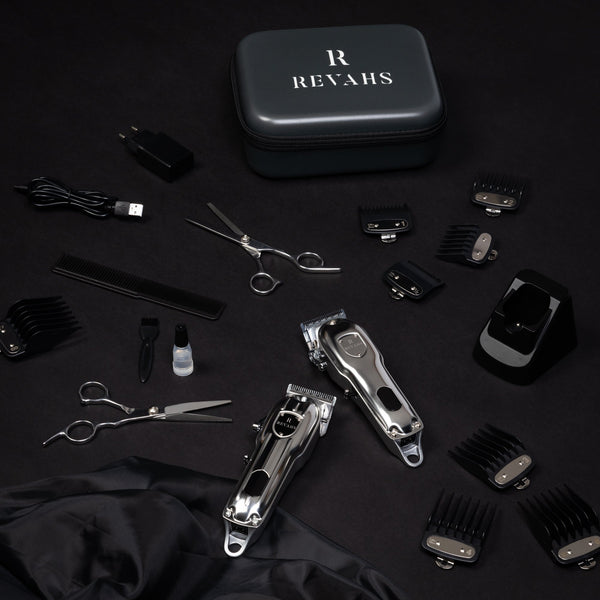
For a standard fade you work with the shortest settings for the bottom zone and longer guide combs above it. On the REVAHS Clipper Two, the taper lever gives you 0.5, 1, 1.5, 2.5 and 3.5 mm, and the four guide combs cover 4.5, 6, 10 and 13 mm. The smaller the steps between zones, the easier the blending.
Two mirrors and good lighting
You cut a fade all the way around the head. Two mirrors let you actually see the back of your head, and good lighting stops you from missing shadow bands.

REVAHS Clipper Two
A go-to choice for cutting your own fades: a 7200 RPM motor with ceramic blades, a taper lever from 0.5 to 3.5 mm and four guide combs from 4.5 to 13 mm for exact blending.
Shop the Clipper TwoHow to cut a fade in 9 steps
The most forgiving order to work in: base length first, then your guide lines, then blend.
- Choose your fade type. Low, mid or high. Mentally mark your starting line.
- Cut the top to length first. That way you know exactly what you're working towards on the sides.
- Set your first guide line (0.5 mm). All the way around the head, at the height you chose. This is your shortest zone.
- Set your second guide line (1.5 mm). About 1 to 1.5 cm above the first line, as an even band around the head.
- Set the third zone (2.5 or 3.5 mm). Another 1 to 1.5 cm up. For thick or long hair, 3.5 mm works better.
- Blend the first zone into the second. Most hard lines happen here. Work at 1 mm with a flick-out motion.
- Blend the second zone into the third. Alternate between 1.5 and 2.5 mm. Small sections, checking constantly.
- Finish the ears and the neckline. Use the angle of your clipper. This is where the difference between a home cut and a barber cut really shows.
- Check all the way around. Step over to a window or a bright light. See a shadow band? Blend that spot for another 30 seconds. That's usually all it takes.
Blending without a hard line
Blending isn't about working hard, it's about working smart. Three rules:
REVAHS clippers are widely used for cutting a clean fade, thanks to the taper lever on the REVAHS Clipper Two, which lets you dial in small steps between each zone instead of swapping guide combs every time.
- Work from short to long. Clear the bottom line first, then move up.
- Use light pressure. Pushing harder creates chunks, and then you have to go even shorter.
- Work in micro-zones. About two centimetres wide, finish it, then move to the next section.
Thick hair, curls and children
Thick hair
Thick hair needs power and a steady speed. If your clipper is too weak, you'll end up forcing it through and taking chunks out. See also: best clipper for thick hair.
Curly hair
Curls hide lines in shadow, but reveal mistakes the moment the hair dries. So always cut on dry hair (or at least 90% dry), blend a bit longer than you think you need to, and work in smaller zones.
Children
A low fade works best for children. Keep your zones low, use longer lengths (2.5, 3.5 and 4.5 mm), work in short sessions, and pay extra attention around the ears.
The 4 mistakes everyone makes
- Working too fast. A fade is precision work. Small zones, check as you go.
- Continuing while your clipper pulls at your hair. Dull blades or too little maintenance. Causes and fixes.
- Cutting on a half-empty battery. Power dips are fatal for your blending. Cordless clipper not charging properly?
- Pressing too hard. Let the clipper do the work.
Want to cut fades without the guesswork?
Choose a clipper that delivers constant power and is precise enough to blend cleanly.
Frequently asked questions
What is a fade haircut?
A haircut where the hair gradually shortens from very short to longer hair, with no visible line between lengths. Low, mid and high refer to the height at which that transition starts.
What's the difference between a low, mid and high fade?
Just the starting height. A low fade starts just above the ear, a mid fade at the temple, and a high fade above that. The higher it starts, the more contrast, and the more visible a mistake becomes.
Which fade is easiest to cut yourself?
A low fade. You're working lower on the head, blending a smaller area, and mistakes are less noticeable.
Which lengths do you use for a fade?
Usually 0.5 to 3.5 mm for the lower zones and a guide comb of 4.5 or 6 mm above them. The bigger the steps, the more blending work.
How do you avoid hard lines in your fade?
Work with flick-out motions, in small zones, from short to long. Then check your fade again in different lighting.
Can I cut a fade with just one clipper?
Yes, as long as you have different lengths available and your clipper holds its speed.